Why Classic Bar Games Still Hold Their Place
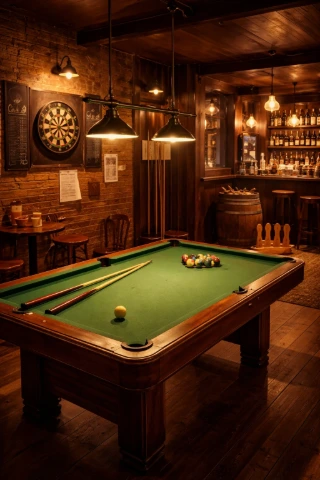
There's something almost defiant about a pool table sitting in the corner of a pub that's been through three ownership changes and a full kitchen renovation. The table stays. So do the darts board, the trivia sheet, and occasionally a set of skittles in the back room. These games have outlasted jukeboxes, fruit machines, and now the slow creep of screens on every surface.
The history runs deep. Skittles, a precursor to modern bowling, was played in English taverns as far back as the 13th century. Quoits, a ring-tossing game with roots in ancient Greece, became a fixture of British pub gardens by the 1800s. Darts formalized into a competitive pub game around the early 20th century, with the British Darts Organisation founding its first structured leagues in 1954. Pool arrived later, spreading through American bars in the 1960s before crossing the Atlantic. Trivia nights are the youngest of the group, emerging in British pubs during the 1970s and exploding in popularity through the 1980s.
Each of these games hit rough patches. The 1990s saw many traditional pub games pushed aside by arcade machines and the shift toward food-led venues. Skittles and quoits nearly vanished outside of rural communities. But the 2010s brought something back. Leagues multiplied, themed quiz nights became a genuine weekly fixture, and a broader cultural hunger for offline socializing gave bar games renewed purpose.
What keeps them alive isn't nostalgia alone. Anyone can pick up a dart without a tutorial. Pool's basic rules take about four minutes to explain. Trivia asks nothing more than a working memory and mild competitive instinct. The cost to play is almost always low. These qualities matter because they remove friction. A group of strangers can share a pool table inside of ten minutes and leave as something closer to acquaintances.
Pool – The Rules Are Simple, but the Etiquette Matters

Eight-ball is the version of pool most commonly played in bars. After the groups are decided, one player aims for balls one through seven, while the other clears nine through fifteen. Once your set is gone, the eight ball becomes the final target and usually has to be sunk in a nominated pocket. Pocketing it before clearing your group, or committing a decisive foul while shooting it, can cost you the game immediately.
Calling shots varies by pub. Some places insist you name the pocket before every shot; others only require it on the eight ball. If you're not sure what the house rule is, ask before the first break. Nobody minds the question. What they do mind is someone quietly changing the rules mid-game when a shot goes wrong.
Taking turns is obvious enough, but the rhythm around the table matters too. When it's not your shot, step back from the table. Don't hover over the rail or chalk your cue while someone else is lining up. Distracting a player mid-shot, even accidentally, is the kind of thing that sours a friendly game fast.
Most bars run a queue system for the table, either a sign-up sheet on the wall or a row of coins left on the rail. If you see coins lined up, that's the waiting list. Add yours at the end. Jumping ahead of it, or pretending you didn't notice, tends to be remembered.
Disagreements happen, usually over fouls or whether a ball was called correctly. Handle them quietly. A calm "I thought you said the corner pocket" lands better than a scene. The unspoken rule in most pubs is that the locals set the tone, and a new player who reads that quickly earns respect a lot faster than one who argues every call. Pool rewards patience at the table as much as it does a decent stroke.
Darts – Precision, Rhythm, and Pub-Side Courtesy
Few bar games have the same combination of accessibility and depth. Anyone can pick up three darts and throw them at a board. Getting consistently good at it is another matter entirely, and that gap between casual and skilled is exactly what keeps people coming back.
The game took root in English pubs sometime in the late 19th century, with organized competition following by the early 20th. By the 1970s, televised darts tournaments were pulling in millions of viewers in Britain, and the board behind the bar had become as expected as a beer tap. That cultural grip never fully loosened.
How the Game Works
Most pub games run on 501, though 301 appears often in shorter sessions. Each player starts at their chosen number and counts downward with every throw, aiming to reach exactly zero. The catch is the finish: to win, a player must land on a double, meaning the narrow outer ring of any numbered segment, or hit the bullseye. Throwing past zero sends the score back to where it was before that round, which is called going bust. A standard turn is three darts, and players alternate until someone closes out.
The Unwritten Rules
Etiquette matters more than newcomers expect. The first rule is simple: never walk to the board to collect your darts while another player is still throwing. It sounds obvious, but crowded bars make people impatient. Give the thrower the entire oche, the throwing line, and a clear sightline to the board. Calling out scores honestly, even when they're bad, keeps the rhythm going and the atmosphere good-humored.
Safety is real too. A dart that slips or bounces off a wire can travel unpredictably. Standing to the side, not behind, is the sensible position.
There's no denying the ritual of it: the stance, the grip, the pause before release. That quiet moment of focus in a noisy room is part of why darts endures.
Trivia Nights and the Social Alchemy of Shared Play
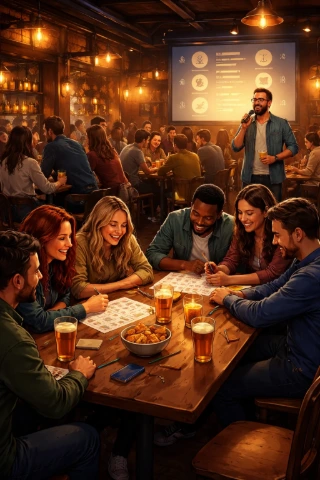
Quiz nights run on a simple format that somehow never gets old. Teams of up to six sign up at the bar, grab an answer sheet, and work through five or six rounds covering anything from geography and science to 1990s pop music and Premier League top scorers. A host – usually someone with a microphone and a taste for bad puns – reads the questions aloud, controls the pace, and calls time. Digital scoring apps have appeared in some venues, but pencil and crumpled paper still dominate most pub quiz nights in Britain and Ireland.
What keeps the room engaged is the deliberate mix of difficulty. An easy opener settles nerves and gets people talking. Then comes something genuinely obscure – the capital of Burkina Faso, say, or the year a specific film won a particular award – that sends every table into urgent, whispered debate. Pop culture rounds tend to cause the loudest arguments, because everyone has an opinion and confidence rarely matches accuracy. Tie-breakers, usually a single numerical question closest to the correct answer, produce a specific kind of tension that pool and darts rarely match.
The social mechanics are where trivia nights earn their reputation. Someone arrives alone, gets folded into a team short on numbers, and spends two hours defending a wrong answer about the periodic table with surprising passion. A group of colleagues who barely speak at the office suddenly discover that one of them knows an alarming amount about 1970s Scandinavian cinema. These moments happen because the game gives people permission to engage with strangers around a shared, low-stakes purpose.
Celebrating a correct answer on a long shot, groaning collectively over a missed gimme, teasing the teammate who confidently wrote the wrong answer – these are the moments that dissolve awkwardness faster than a second round of drinks. The temporary community that forms around a pub quiz table feels real, because in a small but genuine way, it is.
How Bar Games Turn a Quiet Night Into a Weekly Ritual
The strongest bar games do more than fill time between drinks. They create habits. A customer who might visit once every few weeks suddenly has a reason to return every Tuesday for trivia, every Thursday for darts, or whenever their usual pool opponent is around. That predictability matters because it turns an ordinary night out into something people actively plan around.
Games also give a bar an identity without requiring elaborate entertainment. One venue becomes known for its fiercely competitive quiz teams, another for a pool table that always has a queue, and another for a darts league that has been running longer than some of its customers have been alive. The game becomes part of the atmosphere and, eventually, part of the community surrounding the place.
A few qualities help explain why these nights build such loyal followings:
- They create an easy reason to return. A weekly league or quiz night gives people a recurring event without demanding the planning that comes with concerts, parties, or larger nights out.
- They make conversation easier. Asking whose turn it is, debating a trivia answer, or discussing a missed dart gives strangers something immediate to talk about. Nobody has to invent an opening line.
- They reward improvement without requiring expertise. A beginner can still enjoy pool or darts while gradually getting better. Seeing that improvement over several weeks makes returning feel worthwhile.
- They produce harmless rivalries. Regular teams and familiar opponents quickly develop running jokes, remembered victories, and long-standing scores to settle. The competition matters just enough to be interesting without needing to become serious.
- They mix different groups naturally. Age, occupation, and background matter less when everyone is waiting for the same pool table or trying to remember the answer to the same question.
- They generate stories people remember. A ridiculous eight-ball finish, an unexpected bullseye, or the teammate who somehow knew an impossible trivia answer becomes part of the group's shared history.
This repeat value is important because social spaces depend on familiarity. Seeing the same faces week after week changes how a bar feels. Staff learn names, teams recognise one another, and newcomers gradually become regulars. Pool, darts, and trivia survive partly because they create that repetition without making it feel repetitive.
The rules may stay largely the same from one week to the next, but the people, conversations, close finishes, and terrible guesses never do. That combination of familiar structure and unpredictable social moments is difficult to reproduce elsewhere, and it is one of the biggest reasons these games remain embedded in bar culture.
The Games Stay Because the Connection Still Matters
Across decades of changing tastes, shifting drinking habits, and the constant arrival of new entertainment, pool tables still sit under low lights, dartboards still hang at regulation height, and pub quiz sheets still get passed around on Tuesday nights. These games have outlasted trends not because they are cleverly marketed or particularly easy to learn, but because they solve something that no app or streaming service has managed to replace. They give strangers a reason to talk, rivals a reason to laugh, and regulars a reason to come back. The structure they provide – the turn-taking, the scoring, the shared groaning over a missed shot – is really just a framework for the older, simpler business of being around other people without it feeling forced. There's no denying that a bar without a game is just a room with drinks. With one, it becomes somewhere worth staying.