Why Small Rooms Make Big Nights
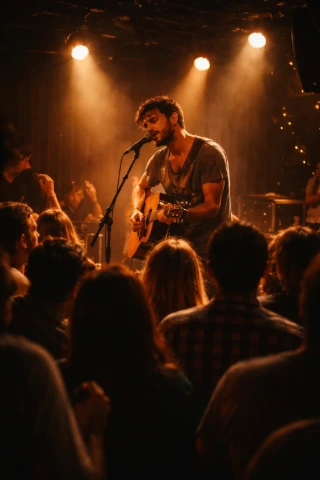
There's something about a venue where you can see the sweat on the performer's forehead that changes the whole experience. Not in a gross way. In a way that makes everything feel real.
Big arenas are impressive. Nobody's arguing that. But impressive and memorable aren't the same thing. When you're in row 47 watching a comedian work a crowd of 8,000, you're basically watching a sports event. The jokes land somewhere between you and the stage and dissipate before they reach your seat.
Squeeze 60 people into a bar backroom with low ceilings and a makeshift stage, though, and the energy has nowhere to go. It just bounces around the room and lands back on everyone. A comedian stumbles over a punchline and the crowd groans, then laughs at the groan. A karaoke singer forgets the second verse of "Don't Stop Believin'" and the whole room starts singing it for them. These moments don't happen at scale.
Cheap drinks help, too. A $7 beer means people are on their third round by 9pm, which means the crowd is warm and generous and slightly too enthusiastic about a stranger's rendition of "Africa" by Toto. That looseness is contagious.
The seating matters more than people realize. When chairs are close together and tables are small, strangers end up sharing space. You make eye contact with the person next to you after a particularly weird joke. You both start laughing at the same time. That's a connection that a 3,000-seat theatre simply cannot manufacture.
Small rooms also move fast. Sets are short, the lineup rotates quickly, and if something isn't working, the night pivots. One act finishes, another starts, and suddenly it's midnight and you've watched six different performers and heard 40 songs and the whole thing felt like it lasted 45 minutes.
That's the trick. Intimacy compresses time in the best possible way.
How Open Mics, Comedy Nights, and Karaoke Actually Work
Most people walk into these nights with zero idea what's actually going on behind the scenes. That's fine. But knowing the basic shape of each format makes the whole experience click faster.
The Open Mic Flow
Sign-up usually happens on a sheet near the bar, anywhere from an hour before showtime to five minutes before the host grabs the mic. Slots are first-come, first-served. Sets run three to five minutes, sometimes a hard six if the host is generous. The host – often a regular performer pulling double duty – keeps the room moving, fills dead air between acts, and quietly manages the clock. Early slots go to newer performers who haven't figured out how to game the list yet. The room is still warming up, so those sets are tougher. By the fourth or fifth act, the crowd has settled in and the energy shifts noticeably.
Comedy Night Lineups
A local comedy night runs a bit tighter. There's usually a proper lineup decided in advance, with a feature act in the middle and a headliner closing. The opener's job is to get the room laughing before they really trust anyone on stage. Sets range from five minutes for newer comics up to twenty or thirty for the headliner. Crowd work – the host or comic riffing directly with the audience – is how dead spots get filled. If someone heckles, that's the host's problem to handle before it derails the next act.
Karaoke Nights
Karaoke runs through a KJ, short for karaoke jockey, who manages the song queue and keeps the energy up between singers. You write your name and song choice on a slip, hand it to the KJ, and wait. Rooms tend to start slow – the first few singers are usually regulars or very confident friends who go early to break the ice. By 10pm, the queue is backed up and the room is loud. Song choice matters more than people think. A deep-cut ballad at 9:15pm lands differently than the same song at midnight.
How to Be the Crowd Everyone Wants Back
Showing up is only half of it. The other half is not being the reason a performer loses their thread mid-set.
Small rooms are brutally honest environments. A 60-seat comedy club or a bar stage packed with 40 people has no acoustic buffer, no distance between you and the act. When someone at table three decides to recap their entire workday to their friend, the comedian hears it. The audience hears it. The moment dies. That's not an exaggeration – it's just physics and proximity.
The Basics That Actually Matter
Arriving late to a small show is more disruptive than people realize. There's no slipping in unnoticed when the room is tiny and the performer is mid-sentence. If doors say 7:30, showing up at 8:15 mid-set is a choice that affects everyone else's night.
Phones are the other obvious one. A lit screen in a dark room is genuinely distracting – to performers and the people sitting near you. Recording a quick clip is usually fine; spending the whole set scrolling is not.
Comedy, Karaoke, and Live Music Each Have Their Own Rules
At a comedy show, your job is simple: laugh if it's funny, stay quiet if it's not, and never heckle unless you're absolutely certain you're funnier than the person on stage. Spoiler – you're not.
Karaoke etiquette is different. Cheering generously for a bad singer is the correct move. That person is brave. Applaud them. The unwritten rule is that everyone gets the same energy, regardless of talent.
Live music in a small room rewards attention. The band can see your face. They know who's actually listening and who's treating them as background noise. Being visibly engaged – nodding, moving, making eye contact – is free encouragement that performers genuinely notice and respond to.
Read the room. Match its energy. That's really the whole thing.
Why Neighbourhood Stages Matter for New Talent
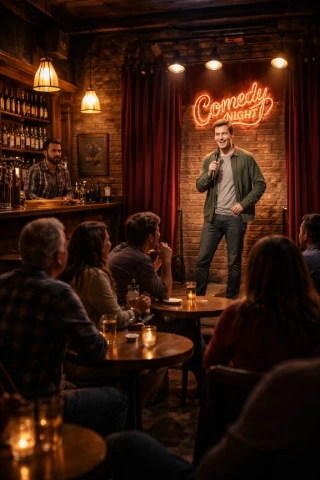
Before anyone sells out a theatre or headlines a festival, they're usually bombing in a back room somewhere, trying out a bit about their landlord to nine people and a bored bartender. That's not a failure story. That's the process.
Small neighbourhood venues are where performers actually learn their craft. A comic doing five minutes at a pub open mic on a Tuesday finds out in real time which jokes land and which ones just hang there. A singer testing new original material at a 30-seat listening room gets instant, unfiltered feedback that no rehearsal space can replicate. The crowd tells you everything – not with forms or reviews, but with their body language and their silence.
There's no denying that confidence is built in small rooms. Playing to ten people who are mostly strangers is genuinely terrifying in a way that's hard to explain until you've done it. Getting through that, making someone laugh or holding someone's attention through a whole song, changes how a performer carries themselves. Then they do it again next week, and the week after. That repetition is where style actually develops.
Local stages also give performers something bigger venues can't offer: the chance to fail without consequence. A rough set at a 40-person comedy night doesn't end a career. It's just a Tuesday. That low-stakes environment is what makes experimentation possible. Some of the most interesting material comes out of those messy, half-formed sets where someone is clearly figuring something out in public.
Regular audiences at these nights play a real role in all of this. Showing up consistently, being genuinely engaged, and not treating an open mic like background noise creates the kind of room where a performer feels safe enough to take risks. A few people who keep coming back matter more than they probably realise. The polished act you see years later? It started somewhere like this.
Why Small Venues Feel More Immersive
A small venue changes the relationship between the audience and the person on stage. There is no distant screen, no enormous lighting rig, and usually nowhere for either side to hide. Every laugh, awkward pause, missed note, and unexpected reaction becomes part of the room. Instead of simply watching a performance, the audience starts to feel involved in how the night develops.
That closeness is especially important for comedy and live music. A comedian can immediately sense whether the crowd wants quicker jokes, more crowd work, or a change of pace. Musicians can soften a song when the room goes quiet or stretch out a chorus when people begin singing along. Even karaoke becomes more entertaining because the singer is performing directly in front of people rather than disappearing onto a distant stage.
Several small details make that atmosphere possible:
- There is immediate feedback. Laughter, applause, silence, and conversation are easy for performers to hear and react to.
- Mistakes feel human rather than disastrous. Forgotten lyrics or missed punchlines can become funny, memorable parts of the night.
- Audience participation happens naturally. People sing along, answer a comedian, cheer for strangers, and react to one another.
- Every seat feels connected to the stage. Even someone standing near the back can usually see facial expressions and small gestures.
- The room develops its own personality. One crowd might be loud and chaotic, while another stays quiet and attentive.
The physical space also changes how people behave. When dozens rather than hundreds of people share a room, audience reactions spread quickly. One person laughing can set off an entire table. A group singing along can pull hesitant people into the chorus. Silence during a quieter song can feel just as powerful because everyone notices when the room suddenly becomes still.
Small venues also create a stronger sense that the night is happening only once. A large tour may repeat essentially the same set across dozens of cities, but a local performance is much more vulnerable to whatever happens in the room. A strange audience comment, an unexpected song request, or a spontaneous joke can push the evening in a completely different direction.
That lack of distance is what makes the experience memorable. The audience is not simply consuming a finished performance. It is helping create the atmosphere around it, which is why even an imperfect night in a packed little room can stay with you longer than a technically flawless show in a much larger venue.
The Best Nights Out Start Close to Home
There's something a bigger venue simply cannot fake – the feeling that you're in the room where it's actually happening. Small comedy nights, karaoke spots, and neighbourhood live music stages deliver closeness, spontaneity, and a shared energy that no 2,000-seat theatre can manufacture. The performer can see your face. You can feel the room shift when a joke lands or a chorus kicks in. That's not an accident – it's what happens when the audience and the act share the same air. So find the smallest venue on your street, turn up with an open mind and a willingness to clap for a stranger, and give it a proper shot. The most memorable night you'll have this month might cost you a £5 door fee and happen in a room above a pub.